

- University
- Academic
- Schools/Vocational Schools
- Vocational School of Justice
- Vocational School
- Vocational School
- Department of Banking and Insurance (Turkish)
- Department of Computer Programming (Turkish)
- Department of Foreign Trade (Turkish)
- Department of Graphic Design (Turkish)
- Department of Interior Design (Turkish)
- Department of Construction Technology (Turkish)
- Department of Occupational Health and Safety (Turkish)
- Department of Media and Communication (Turkish)
- Department of Architectural Restoration (Turkish)
- Department of Radio and Tv Programming (Turkish)
- Department of Civil Aviation Cabin Services (Turkish)
- Department of Civil Aviation Transportation Management (Turkish)
- Department of Tourism and Hotel Management (Turkish)
- Department of Applied English Translation
- Vocational School Of Health Services
- Vocational School Of Health Services
- Department of Child Development (Turkish)
- Department of Physiotherapy (Turkish)
- Department of Paramedic (Turkish)
- Department of Opticianry (Turkish)
- Department of Medical Documentation and Secreteriat (Turkish)
- Department of Medical Imaging Techniques (Turkish)
- Department of Medical Laboratory Techniques (Turkish)
- Department of Elderly Care (Turkish)
- School of Applied Management Sciences
- School of Foreign Languages
- Faculties
- Faculty of Arts and Sciences
- Faculty of Fine Arts and Design
- Faculty of Law
- Faculty of Communication
- Faculty of Business
- Faculty of Engineering
- Faculty of Engineering
- Department of Computer Engineering
- Department of Biomedical Engineering
- Department of Electrical and Electronics Engineering
- Department of Industrial Engineering
- Department of Food Engineering
- Department of Genetics and Bioengineering
- Department of Aerospace Engineering
- Department of Civil Engineering
- Department of Mechanical Engineering
- Department of Mechatronics Engineering
- Department of Software Engineering
- Faculty of Health Sciences
- Medicine
- Graduate School
- Common Courses
- Schools/Vocational Schools
- Research
- Research Centers
- Library
- Smart Campus
- Technology Transfer Office
- İzmir Sciencepark
- Continuous Education Center (EKOSEM)
- Children's University
- Ethics Committee
- Teaching and Learning Center (EKOEĞİTİM)
- Psychology Application and Research Center
- Researcher Training Coordinatorship
- Research Collaborations And Innovation Coordinatorship
- Campus
- INTERNATIONAL
- Contact
- 25TH YEAR
Department of Business Administration
BA 315 | Course Introduction and Application Information
| Course Name |
Creativity and Innovation
|
|
Code
|
Semester
|
Theory
(hour/week) |
Application/Lab
(hour/week) |
Local Credits
|
ECTS
|
|
BA 315
|
Fall/Spring
|
3
|
0
|
3
|
6
|
| Prerequisites |
None
|
|||||
| Course Language |
English
|
|||||
| Course Type |
Elective
|
|||||
| Course Level |
First Cycle
|
|||||
| Mode of Delivery | - | |||||
| Teaching Methods and Techniques of the Course | - | |||||
| National Occupation Classification | - | |||||
| Course Coordinator | ||||||
| Course Lecturer(s) | ||||||
| Assistant(s) | ||||||
| Course Objectives | Creativity is a feature of all human beings, and innovation happens everywhere. The aim of corporate innovation systems is to find and evaluate new ideas and designs, and develop them into products or processes that create the kind of value aligned to firm strategy. This course focuses on principles and practices aimed at fostering creativity and managing innovation. |
| Learning Outcomes |
The students who succeeded in this course;
|
| Course Description | This course focuses on understanding sources of creative ideas within and outside business organizations, stimulating good quality idea creation, understanding nees of customers and internal processes, harvesting ideas, aligning idea screening to corporate strategy, executing and innovation ideas and terminating unsuccessful projects, evaluating innovation performance and costs. This whole process of innovation that starts with idea creation, is aligned to corporate strategy. Students will learn the concepts and practice innovation management as a team using real life challenges |
| Related Sustainable Development Goals |
|
|
|
Core Courses | |
| Major Area Courses |
X
|
|
| Supportive Courses | ||
| Media and Management Skills Courses | ||
| Transferable Skill Courses |
WEEKLY SUBJECTS AND RELATED PREPARATION STUDIES
| Week | Subjects | Related Preparation |
| 1 | Introduction to the course and main concepts | Peter F. Drucker, “The Discipline of Innovation”,HBR,1985. (in-class reading) |
| 2 | Place of innovation in business and economy | Ansoff, H. I. (1957). Strategies for diversification. Harvard business review, 35(5), 113-124. Schumpeter, J. A., & Lekachman, R. L. (1978). Can capitalism survive?. New York: Harper & Row. Chapter 2: “The Process of Creative Destruction” |
| 3 | Creativity in business context: Design thinking. Boxing and unboxing creativity: Focusing on business goals while moving out of the box at the same time | Jeanne M. Liedtka “Ten Tools for Design Thinking”, HBR, 2011 |
| 4 | Group creativity practices and creativity as an iterative process | Jeanne M. Liedtka “Ten Tools for Design Thinking”, HBR, 2011 |
| 5 | Specialized creativity practices: creating user experiences | Reading: “Paronella Park: Innovative attraction” case study |
| 6 | Specialized creativity practices: creating internal processes | Jeanne M. Liedtka “Ten Tools for Design Thinking”, HBR, 2011 |
| 7 | Corporate innovation management: Innovation according to Oslo guidelines, the innovation funnel and measuring innovation activities | Reading: Immelt et al.”How GE is disrupting itself?”, HBR, 2009 |
| 8 | Stage-gate process model of innovation management | Paul Trott “Innovation management and new product development”,Prentice Hall, 2005, “Models of innovation” |
| 9 | Midterm week | |
| 10 | Innovation project planning and execution | Paul Trott “Innovation management and new product development”,Prentice Hall, 2005, “Linear models” |
| 11 | Agile approach to innovation projects | Paul Trott “Innovation management and new product development”,Prentice Hall, 2005, “Interactive model” |
| 12 | Strategic alignment of innovation activities: creating an innovation strategy | Case study: “Valuable collagen production from red meat waste: An innovation story”, Didem Karahıtay Uyğun |
| 13 | Open innovation, innovation outsourcing, crowdsourcing, and financing | Reading: Kızıltunç and Gençer “Contracting for the Unknown: Managing Turkcell’s Agile Innovation Projects with Technology Partners”, case study, 2018 |
| 14 | Protecting innovation vs openness. Patents, licenses and other legal frameworks related to innovation. | Paul Trott “Innovation management and new product development”,Prentice Hall, 2005, Ch5 on “Managing intellectual property” |
| 15 | Student presentations | |
| 16 | Final Exam |
| Course Notes/Textbooks |
|
| Suggested Readings/Materials | - |
EVALUATION SYSTEM
| Semester Activities | Number | Weigthing |
| Participation |
1
|
10
|
| Laboratory / Application | ||
| Field Work | ||
| Quizzes / Studio Critiques |
1
|
30
|
| Portfolio | ||
| Homework / Assignments | ||
| Presentation / Jury |
1
|
30
|
| Project | ||
| Seminar / Workshop | ||
| Oral Exams | ||
| Midterm | ||
| Final Exam |
1
|
30
|
| Total |
| Weighting of Semester Activities on the Final Grade |
3
|
70
|
| Weighting of End-of-Semester Activities on the Final Grade |
1
|
30
|
| Total |
ECTS / WORKLOAD TABLE
| Semester Activities | Number | Duration (Hours) | Workload |
|---|---|---|---|
| Theoretical Course Hours (Including exam week: 16 x total hours) |
16
|
3
|
48
|
| Laboratory / Application Hours |
16
|
0
|
|
| Study Hours Out of Class |
14
|
3
|
42
|
| Field Work |
0
|
||
| Quizzes / Studio Critiques |
1
|
20
|
20
|
| Portfolio |
0
|
||
| Homework / Assignments |
0
|
||
| Presentation / Jury |
1
|
44
|
44
|
| Project |
0
|
||
| Seminar / Workshop |
0
|
||
| Oral Exam |
0
|
||
| Midterms |
0
|
||
| Final Exam |
1
|
14
|
14
|
| Total |
168
|
COURSE LEARNING OUTCOMES AND PROGRAM QUALIFICATIONS RELATIONSHIP
|
#
|
Program Competencies/Outcomes |
* Contribution Level
|
|||||
|
1
|
2
|
3
|
4
|
5
|
|||
| 1 |
To be able to solve problems with an analytical and holistic viewpoint in the field of business administration. |
-
|
-
|
-
|
X
|
-
|
|
| 2 |
To be able to present the findings and solutions to the business problems in written and oral formats. |
-
|
-
|
X
|
-
|
-
|
|
| 3 |
To be able to interpret the application of business and economic concepts, and philosophies at the national and international levels. |
-
|
-
|
-
|
-
|
-
|
|
| 4 |
To be able to use innovative and creative approach for real-life business situations. |
-
|
-
|
-
|
X
|
-
|
|
| 5 |
To be able to demonstrate leadership skills in different business situations. |
-
|
-
|
-
|
-
|
-
|
|
| 6 |
To be able to interpret the reflections of new technologies and softwares to business dynamics. |
-
|
-
|
-
|
-
|
-
|
|
| 7 |
To be able to integrate knowledge gained in the five areas of business administration (marketing, production, management, accounting, and finance) through a strategic perspective. |
-
|
-
|
X
|
-
|
-
|
|
| 8 |
To be able to act in accordance with the scientific and ethical values in studies related to business administration. |
-
|
-
|
-
|
-
|
-
|
|
| 9 |
To be able to work efficiently and effectively as a team member. |
-
|
-
|
-
|
-
|
-
|
|
| 10 |
To be able to have an ethical perspective and social responsiveness when making and evaluating business decisions. |
-
|
-
|
-
|
-
|
-
|
|
| 11 |
To be able to collect data in the area of business administration and communicate with colleagues in a foreign language ("European Language Portfolio Global Scale", Level B1). |
-
|
-
|
-
|
-
|
-
|
|
| 12 |
To be able to speak a second foreign language at a medium level of fluency efficiently. |
-
|
-
|
-
|
-
|
-
|
|
| 13 |
To be able to relate the knowledge accumulated throughout the human history to their field of expertise. |
-
|
-
|
-
|
-
|
-
|
|
*1 Lowest, 2 Low, 3 Average, 4 High, 5 Highest
NEWSALL NEWS

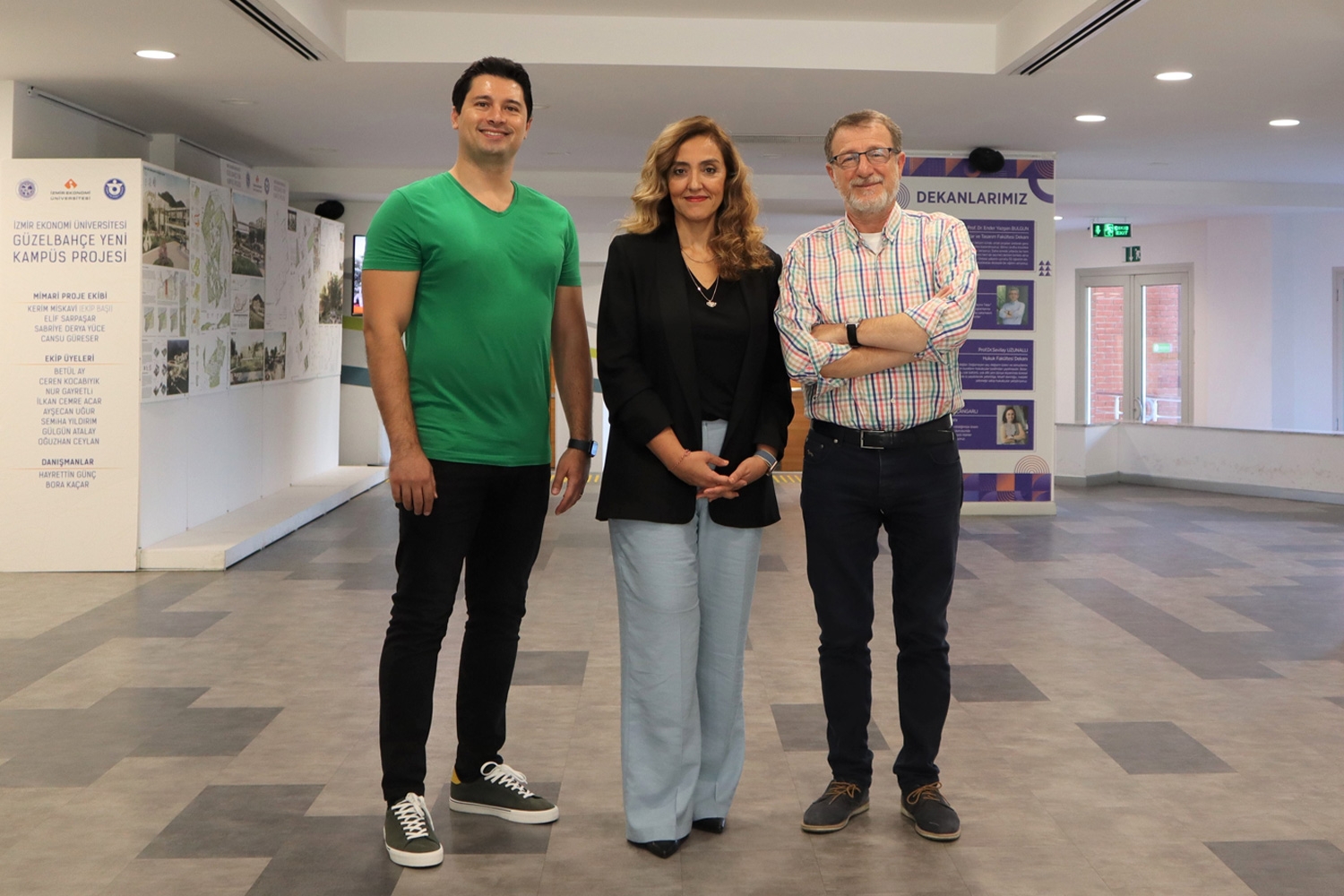



IZMIR UNIVERSITY OF ECONOMICS GÜZELBAHÇE CAMPUS
DetailsGLOBAL CAREER
As Izmir University of Economics transforms into a world-class university, it also raises successful young people with global competence.
More..CONTRIBUTION TO SCIENCE
Izmir University of Economics produces qualified knowledge and competent technologies.
More..VALUING PEOPLE
Izmir University of Economics sees producing social benefit as its reason for existence.
More..
You are one step ahead with your graduate education at Izmir University of Economics.